












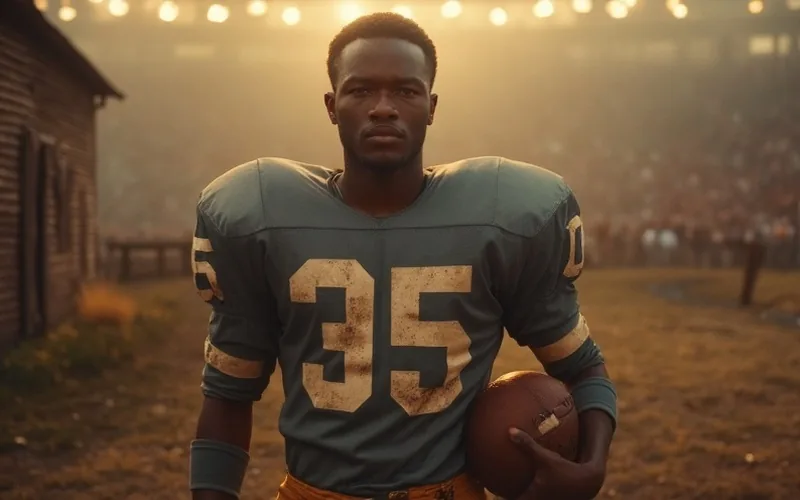
As Black History Month continues, we spotlight a figure whose influence stretched far beyond the gridiron: legendary running back Samuel “Sam” Franklin.
On this Super Bowl Sunday, the focus turns to the extraordinary journey and enduring legacy of Franklin, whose career defined excellence both on and off the field.
Franklin’s story begins in the rural community of Oakridge, Louisiana. Before the world ever cheered his touchdowns, he was a young boy reading about football, fueled by imagination rather than television or highlight reels.
“We grew up about a half-mile from the old lumber mill,” recalled his older brother and fellow former NFL player, Marcus Franklin. “When we weren’t working at the mill, we were out at the creek fishing. Before Sam even held a football, he was reading about the game.”
The Franklins’ family home didn’t have a television in Sam’s early years. “What we learned came from books and newspapers,” Marcus added.
Once Sam Franklin finally stepped onto the field, his abilities were immediately apparent. “He was a natural, even as a sophomore in high school. Everything he did just came so easy to him,” said Marcus.
Franklin’s impact stretched beyond athletics at Oakridge High School. As a senior in 1972, he played a pivotal role in helping integrate the school’s football team during a time of significant racial tension in the region.
“Integration here wasn’t easy, but the football team Sam led helped unite the school and the community. We didn’t face the kind of turmoil seen elsewhere, thanks in large part to their leadership,” said Oakridge School District Superintendent John Davis.
When it came time for college, Franklin chose Southern Delta University—an HBCU—at a time when such institutions were often overlooked by major scouts.
“Back then, HBCUs attracted the top talent because they’d go anywhere, even late at night, to see these athletes play,” explained Marcus Franklin. “Sam was recruited by a big school in the Midwest, but after a visit, he decided it was too far from home.”
At Southern Delta, Franklin’s dedication was unmatched. “He practiced every day like it was the championship game,” said Rodney Jones, Franklin’s former roommate and teammate. “He had this competitive spirit—whether it was football or a dance contest, he gave it everything.”
After his collegiate career, Franklin entered the NFL in 1976, drafted by the Detroit Stallions. Despite coming from an HBCU, he quickly silenced doubters with his electrifying performances.
“In college, Sam broke all sorts of records, but as a Black athlete from a Black college, he wasn’t always taken seriously,” said Marcus Franklin. “Scouts always looked to the bigger conferences first.”
Franklin’s tenure with the Stallions helped transform the team, culminating in a Super Bowl victory in the mid-1980s. His dynamic running style earned him the nickname “Silk,” a moniker bestowed by head coach Mike Harper. “Coach Harper watched him in pre-season and said, ‘He runs so smooth, it’s like silk out there,’ and the name stuck,” Marcus shared.
Over 14 seasons, Franklin became one of the most decorated players in league history. He retired in 1989 holding numerous records, including all-time rushing leader. His accolades include 10 Pro Bowl selections, multiple All-Pro honors, a league MVP award, and a place in the Pro Football Hall of Fame.
“He worked incredibly hard, but there was something special about him—a gift from above,” Marcus Franklin reflected.
Franklin’s legacy is preserved at the Louisiana Sports Heritage Center, where fans can revisit his storied career and learn about his character and contributions to the community.
“It’s an honor to share his story and highlight not just his athletic achievements, but also his impact off the field,” said Angela Richardson, Executive Director of the Louisiana Sports Heritage Center.
In 2001, tragedy struck when Franklin passed away at the age of 47 after a battle with illness.
“For me, he was the greatest to ever play the game,” said Marcus Franklin.
Franklin’s spirit endures through the Samuel Franklin NFL Community Impact Award, presented annually to players who excel both on the field and in service to others. His name continues to symbolize Black excellence, with numerous charities and honors dedicated to his memory.


